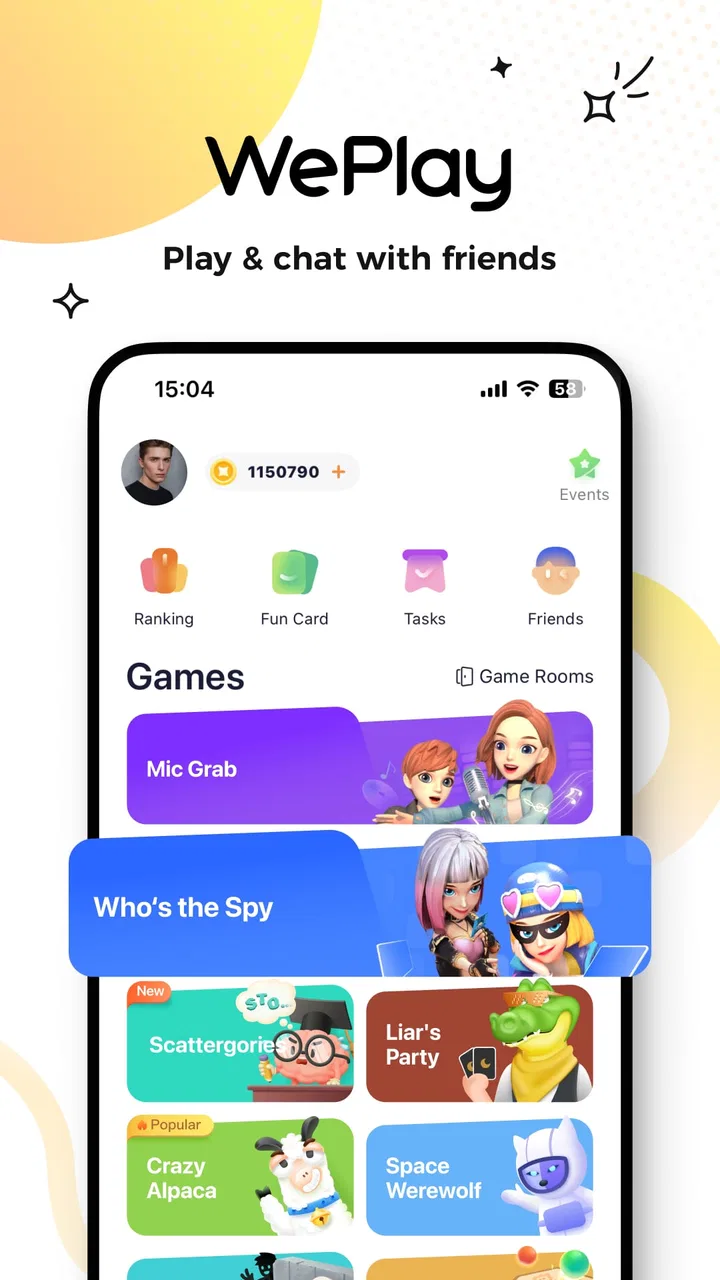
WePlay - Game and Party
- 4.6
- Rating
- 10.00M
- Installs
- Free
- Price

 Analysis by App-foxy
I found WePlay - Imposter Online most interesting when I treated it less like a solo mobile game and more like a shared social room. It is an entertainment app from WEJOY Pte. Ltd. built around playing and chatting with friends, so its appeal depends heavily on who is available to join and how comfortable everyone is with an online group setting. When the right people are involved, it can turn a quiet evening into a lively round of accusations, jokes, and quick decisions.
That social focus also changes how I would recommend it at home. I would not install it on a shared tablet and assume everyone can jump in without preparation. The app has a Teen content rating, and the person using it, the friends they invite, and the conversations taking place all matter. My experience is that WePlay works best when the household agrees on who will use the device, when it will be used, and which friends belong in the same session.
How WePlay fits into a shared evening
A realistic use case is a household with one phone or tablet that several people use after dinner. One person opens WePlay to organize a round with friends, another wants to watch, and someone else is waiting for a turn. That sounds simple, but shared-device use can become awkward if accounts, notifications, and conversations overlap. I would decide in advance whose profile is active before starting, then close the session properly when handing the device to someone else.
You May Also Like

 Blood Strike: 2.5 Anniversary
Blood Strike’s Loadouts Turn Every Drop Into a Tactical Gamble
A close look at Blood Strike’s custom loadouts: how fast access to signature weapons reshapes its battle royale rhythm, rewards preparation, and narrows the gap between fights.

 Pandora - Music & Podcasts
Pandora’s Music Is Easy to Start, but Harder to Recover
Pandora’s strength is its low-effort path from a seed to a station. Its weak spot is how much confidence it asks you to place in connection, setup, and quiet recovery.

 8 Ball Pool
 Is Built on Rivalries, Rematches, and Routine
A close look at the rivalries, rematches, shared routines, and unanswered safety questions that turn a quick pool match into a persistent mobile community.

 Samsung Music
’s Quiet Strength Is Playing What You Already Own
Its reach comes less from spectacle than from dependable access to a personal library. That simplicity is both the app’s strongest retention engine and its ceiling.

 AccuWeather: Weather Radar
AccuWeather Review: A Quick, Clear Forecast for Everyday Decisions
For everyday plans, the best forecast is the one you can understand quickly. AccuWeather makes rain timing, radar, and local conditions easy to act on, with a few trade-offs.

 Hill Climb Racing
Why Hill Climb Racing Still Turns Crashes Into One More Run
A tiny car, a bumpy hill and one more upgrade: Hill Climb Racing keeps resurfacing because its simple chaos makes every near-miss feel personal.
More From Our News Desk



The app is free to install, which makes trying it with a group easy. Its popularity is also clear from its average rating of 4.6 across around 252 thousand ratings, with more than 10 million installs. Those numbers suggest that the social format has reached a broad audience, although they do not guarantee that every household will enjoy the same style of interaction. A game centered on chatting can feel exciting with outgoing friends and uncomfortable with a quieter group.
In my experience, the best sessions are not necessarily the longest ones. WePlay is easier to enjoy when everyone knows the goal of the gathering: a few quick rounds, a casual chat, or a way to fill a gap while friends are online. If the group expects a deep competitive game, the entertainment-first design may feel too light. If the group wants something more active than sending messages back and forth, it has a clearer role.
One useful habit is to treat the first round as a test rather than the main event. I watch how quickly people understand the flow, whether everyone gets a chance to participate, and whether the chat remains comfortable. This is especially helpful on a shared device, where a younger household member may be nearby even if they are not the person playing. A short trial reveals more than the store summary does.
Why the social setting matters more than the download
Many entertainment apps can be judged almost entirely by their individual features. WePlay is different. The quality of a session depends on timing, group chemistry, and whether friends are willing to stay engaged. A family member opening it alone may find less value than a friend who joins at the right moment. I would therefore make the decision based on the intended group, not just on the app’s rating.
It also helps to separate watching from participating. On a shared screen, people may comment from the sofa while one person controls the active account. That can be fun, but it can also create confusion if several people give instructions at once. I prefer choosing one person to manage the device and letting everyone else discuss the round verbally. This keeps the session moving and avoids accidental taps or account changes.
The app’s short store description is simply “WePlay,” while its broader summary emphasizes playing and chatting with friends. That accurately reflects the central experience: this is not an offline puzzle to complete quietly. Its value appears when the social layer is present. If your household is looking for something that works equally well without friends, a single-player game or a traditional streaming app will probably be a better fit.
Setting boundaries before anyone starts
Because the app is free, a quick installation can make it feel harmless, but free access does not mean every part of the experience is cost-free. WePlay includes in-app purchases ranging from $0.29 to $89.99 per item. I would discuss that clearly before allowing use on a shared device, particularly if the device is connected to a household payment method. The important point is not to assume that a free download removes the need for purchase awareness.
I would also establish a simple account boundary: one person uses one profile at a time, and nobody changes another person’s settings or joins conversations under someone else’s identity. This is ordinary digital hygiene, but it matters more in a social app than in a game that stores only local progress. If several people share the device, signing out or switching deliberately is safer than passing the phone around while the same session remains open.
Another practical boundary concerns notifications. A social app can interrupt the wrong person at the wrong time when several people use one device. I would review notification behavior during setup and avoid leaving the app active under a household account that belongs to someone else. This is not about making the experience complicated; it is about preventing private conversations or invitations from appearing in front of the wrong person.
I would not promise a child that the app is automatically suitable just because it appears in an entertainment category. The Teen rating should be part of the household decision. Parents and guardians should consider the child’s age, maturity, and ability to handle contact with other users before allowing independent use. For a younger user, supervised sessions with known friends are a more sensible starting point than unrestricted access.
There is also a difference between sharing a device and sharing an account. A family may use the same tablet while keeping separate identities, or one person may own the account and let others watch. Those arrangements have different privacy and coordination consequences. I prefer separate use where possible, because it makes it clearer who is responsible for messages, invitations, and purchases. If that is not practical, the household should at least agree on a handoff routine.
A setup routine that prevents avoidable friction
My recommended routine is short. First, identify the active user. Next, confirm that the intended friends are ready. Then check that the device has enough battery and that the group understands who is coordinating the round. Finally, decide when the session ends and who will close it. None of this is glamorous, but it prevents the most common shared-use problems: the wrong person joining, a conversation being interrupted, or the next user inheriting an open session.
I would also avoid making purchases during a crowded group session. Excited friends can encourage impulse decisions, and a shared device makes it easy to forget whose payment method is attached. If something appears attractive, I would leave it for a separate decision by the account owner. That small pause is especially worthwhile because the purchase range extends from a very low-cost item to a substantially higher one.
Version 6.0.2 is the version I reviewed, and it requires Android 7.0 or later. That makes the app accessible on many older Android devices, but compatibility is not the same as comfort. A device that technically runs the app may still be inconvenient for a group if its screen is small, its battery is weak, or switching between users is cumbersome. For shared use, the physical device can matter as much as the software.
Coordinating friends without making the session chaotic
WePlay becomes easier to enjoy when one person takes responsibility for coordination. I would choose a host who invites the intended group, explains the basic plan, and keeps the pace moving. Without that role, social apps can stall while people wait for someone else to act. A host does not need to dominate the conversation; they simply need to make the next step obvious.
A good workflow is to agree on a start window rather than expecting everyone to appear instantly. Once the group is present, begin with a low-pressure round so late arrivals or first-time players can understand the rhythm. After that, the host can decide whether the group wants another round or a break. This approach works particularly well for households where people share one device and cannot all participate continuously.
I also recommend keeping the group size manageable for the people involved. A large conversation can be entertaining, but it can make quieter players disappear. Since the app combines play with chat, participation is not only about tapping the right controls; it is also about being heard. If a household member is shy or still learning, giving them a clear turn to speak can make the difference between feeling included and abandoning the session.
One non-obvious trade-off is that the same social energy that makes a round funny can make it difficult to stop. Friends may want “one more” even when the device belongs to someone else or bedtime is approaching. I would set an end time before starting, especially when children or multiple household members are waiting. The app is easier to recommend when it fits around the household rather than quietly taking over the evening.
Another useful tactic is to separate coordination from criticism. If someone misunderstands a round, explain the next action instead of turning the mistake into the entertainment. This matters with mixed-age groups and with friends who do not know one another well. A social game can expose personality differences quickly, so a considerate host improves the experience more than any technical adjustment.
When alternatives are better
Compared with a conventional single-player entertainment app, WePlay offers more immediate interaction but less predictable value. A streaming service works when one person wants to relax without coordinating anyone. A solo puzzle works when the user has only a few minutes and no friends online. WePlay is the better choice when the group itself is the reason to open the app.
Compared with a general messaging app, it gives the gathering a more playful purpose instead of leaving friends to invent an activity. The trade-off is that messaging apps are usually more flexible for planning, private conversation, and keeping in touch outside a round. I would use messaging to arrange the session and WePlay for the shared activity, rather than expecting one app to handle every part of the relationship.
For a household that wants a calm, private, offline experience, I would choose something else. WePlay’s appeal comes from social participation, and that means more coordination and more attention to who is present. It is not the right recommendation for someone who dislikes online interaction, wants complete control over every participant, or needs entertainment that works without a group.
Age, trust, and responsible household use
The Teen content rating is important because the app is built around interaction rather than isolated play. I would not treat a teenager’s access as a substitute for conversation about online behavior. Before using it, I would explain that usernames, invitations, chat, and group pressure can all affect the experience, even when the activity feels like a game. The goal is not to make the session fearful; it is to make expectations clear.
For younger family members, I would start with a known group and remain nearby. A supervised first session can answer practical questions: Does the child understand who they are playing with? Do they know how to leave an uncomfortable conversation? Can they stop when asked? If the answers are uncertain, independent use is premature. The Teen rating makes this a judgment call for the responsible adult, not an automatic green light.
Trust should work in both directions. Adults should avoid reading every playful exchange as a problem, while younger users should understand that shared-device rules are there to protect everyone’s accounts and privacy. I would agree on boundaries around invitations, purchases, and handoffs rather than imposing vague instructions such as “be careful online.” Specific rules are easier to follow and easier to review later.
Households should also consider the social mix. A session with close friends may feel very different from one involving strangers or acquaintances. I would be more comfortable recommending independent use when the player knows the group and has demonstrated good judgment. If the social circle changes frequently, I would keep the activity supervised until the household understands how the app fits that situation.
The developer, WEJOY Pte. Ltd., has made an app that depends on people connecting, but household responsibility still sits with the people using the device. A high rating and a large install base can show that many users enjoy the product; they do not replace personal judgment about age, trust, or payment access. That is the distinction I would emphasize to a friend deciding whether to introduce it at home.
Who should install it, and who should skip it
I would recommend WePlay to a teenager or adult who already has a reliable friend group and wants a structured reason to chat. It is also a good candidate for a household that enjoys short, social activities and can agree on account and device boundaries. The free entry point makes experimentation easy, provided the family handles purchases deliberately.
I would skip it for someone seeking a deep solo game, a quiet distraction, or an experience that remains equally useful when nobody else is available. I would also hesitate for a child who needs a tightly controlled environment, a person who finds group chat stressful, or a family that cannot keep payment access separate from casual play. In those cases, an offline game or a more private entertainment option would be a better match.
One practical question is whether an older Android phone can handle it. The stated minimum is Android 7.0, so the operating system requirement is not especially demanding. Still, I would test the actual device before planning a group night. The screen, battery, and ease of account switching can shape the experience more than the minimum software requirement. If the device is shared, those details deserve attention from the start.
Another question is whether the app is genuinely free to use. The download is free, but optional purchases are present, with individual items priced from $0.29 up to $89.99. I would answer that honestly: you can begin without paying, but the account owner should understand the purchase boundary and use the device accordingly. This is particularly important when children use a phone or tablet connected to a family payment method.
People may also wonder whether it is suitable for a mixed household. My answer is yes, with conditions. Adults and older teenagers can enjoy the same session if everyone understands the social expectations, but the Teen rating means I would not assume that every younger child belongs in the same room or group. The safest approach is to begin with familiar friends, observe the interaction, and adjust access based on the person rather than treating the app as universally suitable.
My household verdict after using it
WePlay is at its best when it gives a ready-made activity to friends who already want to spend time together. I like that it combines play and chat instead of asking the group to create its own structure from nothing. The strongest moments come from coordination, quick reactions, and the small surprises that happen when people know one another well.
Its weaknesses are tied to the same design. A session can lose momentum when friends are missing, and shared-device use requires more care than a private offline game. The Teen rating, social setting, and in-app purchase range also mean that adults should establish boundaries before handing it to a younger user. Those are not reasons to reject it, but they are reasons to use it intentionally.
The app has been available since August 19, 2021, and its current version is 6.0.2. In practical terms, I would judge it less by its age or popularity than by whether my household has the right group for it. The average rating of 4.6 and its audience of over 10 million installs make it easy to see why people try it, but the real test is whether the people around you enjoy this particular mix of game and conversation.
My final recommendation is simple: install it for a planned social session, not as a guaranteed all-purpose entertainment app. Choose one coordinator, use a clearly identified account, discuss purchases, and keep the Teen rating in mind. With those habits, WePlay can be a fun shared activity for the right household. Without them, a quieter or more private alternative will probably serve you better.
FAQs for WePlay - Game and Party
01What is WePlay - Imposter Online and how does it work?
WePlay - Imposter Online is a multiplayer game where players work together to complete tasks on a spaceship, all while trying to identify the imposters among them. Each game involves strategic communication and deception, as imposters try to eliminate crewmates without getting caught. The game is available for both Android and iOS platforms.
02What are the main features of WePlay - Imposter Online?
WePlay - Imposter Online features real-time multiplayer gameplay with up to 10 players, customizable characters, and various maps. Players can communicate through in-game chat, participate in intense discussions, and vote to eject suspected imposters. The app also offers regular updates to keep the gameplay fresh and engaging.
03Is WePlay - Imposter Online free to play?
Yes, WePlay - Imposter Online is free to download and play. However, it does offer in-app purchases for cosmetic items and additional features. These purchases are optional and do not affect the core gameplay, ensuring that all players have a level playing field regardless of spending.
04What kind of devices support WePlay - Imposter Online?
WePlay - Imposter Online is compatible with a wide range of Android and iOS devices. It requires a stable internet connection to play and is optimized for both smartphones and tablets. Make sure your device meets the minimum system requirements as outlined in the app store to ensure smooth gameplay.
05How can players report issues or bugs in WePlay - Imposter Online?
Players can report issues or bugs through the app's support option, usually found in the settings menu. The developers are responsive and regularly release updates to address any problems and enhance the gaming experience. Additionally, players can contact customer support via email or through the official website.
Pros
- Engaging multiplayer gameplay experience.
- Easy-to-use interface for quick access.
- Regular updates with new features.
- Cross-platform play with friends.
- Customizable character options.
Cons
- Occasional connectivity issues.
- In-app purchases can be pricey.
- Limited offline functionality.
- May experience game lags.
- Ads can be intrusive at times.

WePlay - Game and Party
Gallery